Formerly known as Toyota Material Handling Northern California, TMHNC

Forklift Hydraulic Service: Why Hydraulic Filter Maintenance Matters
Table Of Contents
hide
Your forklift’s hydraulic system goes to work every time you lift, lower, tilt, or handle a load. When that system is working properly, you probably don’t think much about it. But when hydraulic performance starts to suffer, it can quickly impact productivity and lead to unexpected downtime.
That’s why preventive hydraulic maintenance matters.
Regular hydraulic service helps protect critical components, maintain dependable performance, and identify potential problems before they become more expensive repairs. Toyota Forklifts emphasizes that following scheduled maintenance can help prevent minor wear from turning into larger repair issues and improve equipment uptime.
And right now, there’s an even better reason to stay ahead of your maintenance.
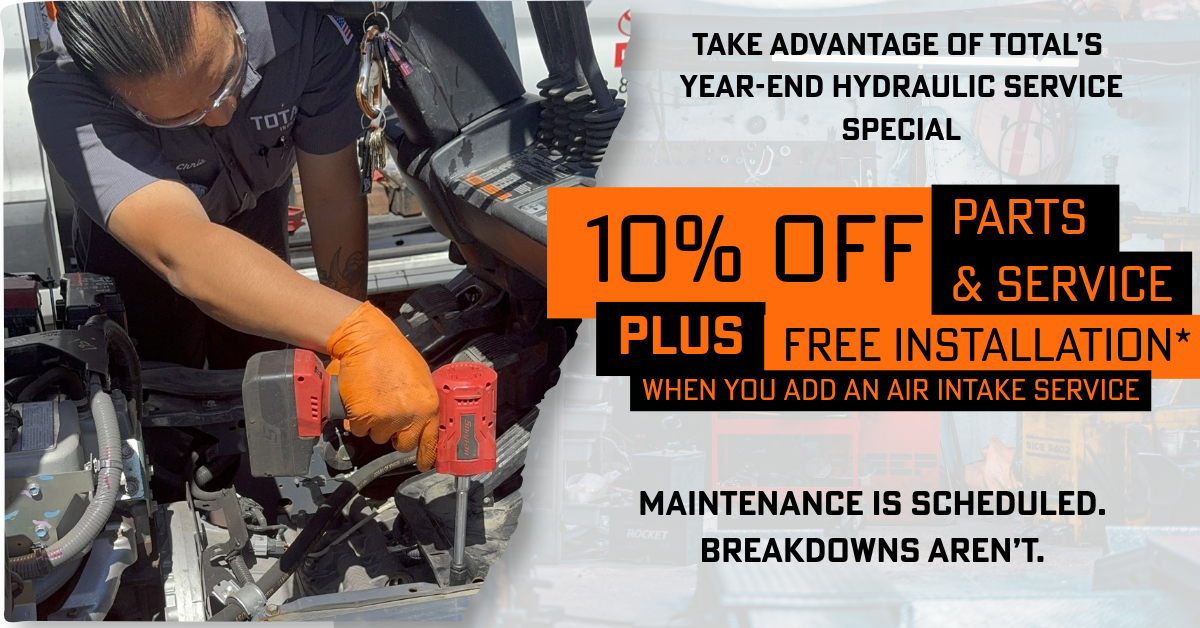
Save 10% on Hydraulic Parts & Labor Through the End of the 2026 Year
For a limited time, Total Industries customers can receive:
10% OFF hydraulic service parts and labor through December 31, 2026.
Plus, customers who add an Air Intake Service can receive FREE installation.*
It’s an opportunity to take care of maintenance your forklift needs while saving on the cost of service.
But why is hydraulic service so important in the first place?
What Does Your Forklift’s Hydraulic System Actually Do?
Think about how frequently a forklift lifts, lowers and tilts throughout a normal shift. The hydraulic system is responsible for transferring the power necessary to perform these functions.
Hydraulic fluid plays a critical role in transmitting that energy through the system. Toyota Forklifts notes that inadequate hydraulic fluid levels can result in decreased lifting and steering capabilities.
And that fluid needs to stay clean.
That’s where filtration comes in.
What Does a Hydraulic Filter Do?
Your hydraulic filter is one of the system’s lines of defense against contaminants circulating through the hydraulic fluid.
Over time, hydraulic systems can be exposed to contaminants and normal wear debris. Proper filtration helps keep unwanted particles from continuously circulating through components that depend on clean hydraulic fluid.
It’s a relatively straightforward piece of preventive maintenance that can help protect a much larger, more expensive system.
The goal isn’t simply to replace a filter. It’s to protect the components downstream from it.
Why Should I Replace My Forklift’s Hydraulic Filter?
There are a few big reasons.
1. Protect Critical Hydraulic Components
Your forklift’s hydraulic system contains components that work together every time the machine handles a load. Keeping the hydraulic system properly maintained helps protect those components and their service life.
Toyota Forklifts specifically warns that going too long without changing hydraulic fluid can risk the service life of other components throughout the hydraulic system.
2. Help Maintain Reliable Performance
A forklift is there to work.
When hydraulic maintenance is neglected, you’re taking a chance with one of the systems the machine depends on to perform its core functions.
Staying on top of scheduled service helps keep the system maintained rather than waiting for a performance issue to tell you something is wrong.
3. Reduce the Risk of Unplanned Downtime
Scheduled service can be planned around your operation.
A breakdown usually can’t.
Preventive maintenance provides an opportunity to identify developing problems while they are still manageable rather than discovering them when the forklift is already out of service.
Toyota Forklifts specifically identifies increased uptime and the opportunity to discover issues before they become more expensive repairs as benefits of proper planned maintenance.
4. Protect the Life of Your Equipment
Forklifts are a significant investment, and proper maintenance is part of protecting that investment.
Toyota Forklifts describes consistent maintenance as an important factor in maximizing equipment lifespan. Regular replacement of service items also helps support the long-term value and ROI of the forklift.
5. Give Your Technician an Opportunity to Catch Other Problems
There is another benefit to having your forklift serviced before something breaks: someone is looking at the machine.
Scheduled maintenance gives a trained technician an opportunity to inspect the forklift and identify signs of wear or developing problems that might otherwise go unnoticed.
That can mean the difference between“Let’s schedule this repair” and“This forklift is down until we fix it.”
How Often Should a Forklift Hydraulic Filter Be Changed?
Service requirements vary based on the forklift model, fuel type, operating hours, application and working environment.
As a general framework, Toyota Forklifts lists hydraulic filter replacement among the deeper services commonly performed around the 2,000-hour or 12-month interval. However, we recommend checking the operator’s manual for the maintenance schedule for the individual machine.
Hydraulic fluid may have a different interval. Many forklift manufacturers recommend hydraulic fluid replacement around 1,000 operating hours, but equipment-specific recommendations should always take priority.
And operating conditions matter.
A forklift operating in a clean indoor warehouse doesn’t necessarily experience the same conditions as equipment working in a dusty yard, manufacturing facility, agricultural application or other demanding environment.
That’s another reason maintenance shouldn’t be treated as one-size-fits-all.
What Happens If I Put Off Hydraulic Service?
This is where preventive maintenance becomes a business decision, not just a service recommendation.
Putting off maintenance may save you the cost of service today, but it can expose the forklift to greater risk of:
- Reduced hydraulic performance
- Premature component wear
- Unplanned downtime
- More extensive repairs
- Lost productivity while the forklift is out of service
- Shortened equipment life
Toyota Forklifts notes that extending hydraulic fluid changes for too long can risk the service life of other hydraulic system components.
That’s why we like to put it simply:
Maintenance is planned. Downtime isn’t.
How Can Preventive Hydraulic Service Save Me Money?
There’s the immediate savings, and then there’s the potentially much bigger operational savings.
Immediate Savings
Through December 31, 2026 you can save:
10% on hydraulic service parts and labor.
If the normal qualifying parts and labor portion of a service were $500, for example, 10% would mean $50 in promotional savings. On $1,000 in qualifying parts and labor, that’s $100 in savings.
Actual service cost and savings will depend on the forklift, required parts, labor and terms of the promotion.
Potential Long-Term Savings
The larger value of preventive maintenance is avoiding the“run it until something breaks” approach.
A major hydraulic repair doesn’t only involve the repair invoice. Depending on the situation, businesses can also face:
Repair cost + lost production + employee downtime + scheduling disruption
That’s why the cheapest repair is often the problem you catch early.
Toyota Forklifts says scheduled maintenance makes major issues more likely to be discovered before they become more expensive repairs, while proper maintenance can also increase uptime and extend forklift life.
Forklift Hydraulic Service FAQs
How do I know if my forklift needs hydraulic service?
The best starting point is your forklift’s recommended maintenance schedule and operating hours. Don’t wait for a noticeable performance problem before scheduling preventive service.
Isn’t changing the hydraulic filter something I can wait on until there’s a problem?
That’s exactly what preventive maintenance is designed to avoid. Regular service addresses maintenance items before a failure or performance problem forces the issue.
Is hydraulic fluid the same thing as the hydraulic filter?
No. The hydraulic fluid transfers energy through the system, while filtration helps keep contaminants from circulating through that fluid. Both play an important role in hydraulic system maintenance.
Toyota Forklifts describes hydraulic fluid’s primary function as energy transmission through the hydraulic system.
Is hydraulic filter replacement the same for every forklift?
No. The correct parts and service intervals depend on the specific equipment. Providing the model and serial number allows a dealer to identify the proper replacement parts for a particular forklift.
Can Total Industries tell me if my forklift is due?
Yes. Contact our service team with your forklift information and operating hours, and we can help determine the appropriate service for your equipment.
While You’re Taking Care of Your Forklift, Don’t Forget the Air Intake
his is where I would shift gears and make the secondary offer feel like a natural add-on instead of letting it compete with your hydraulic promotion.
For internal combustion forklifts, clean air is also an important part of keeping the engine operating properly.
Air filters are a routine forklift replacement item, and Toyota’s standard maintenance framework calls for air filter inspection/cleaning as early as the 250-hour or approximately six-week service interval, depending on the specific equipment and operating conditions.
Why Does Air Intake Service Matter?
Your forklift operates in environments where dust, dirt and debris may be part of the job.
The air filtration system helps prevent those contaminants from being pulled into the engine. Keeping the air intake system properly serviced helps support:
- Cleaner air entering the engine
- Reliable engine performance
- Protection from dust and debris
- Proper preventive maintenance
- Long-term equipment reliability
And just like your hydraulic filter, an air filter is a relatively small maintenance item that’s protecting much more expensive equipment.
Two Services. One Opportunity to Get Ahead on Maintenance.
If hydraulic or air intake maintenance has been sitting on your to-do list, now is a good time to take care of it.
Through December 31:
✓ Save 10% on Hydraulic Parts & Labor
✓ Add an Air Intake Service and Receive FREE Installation*
✓ Help Protect Your Equipment
✓ Stay Ahead of Unexpected Downtime
Don’t wait for a hydraulic problem to stop your operation.
Contact Total Industries today to schedule your hydraulic service before the year-end promotion ends.
Promotion terms, equipment eligibility and service availability may apply. Contact Total Industries for details.